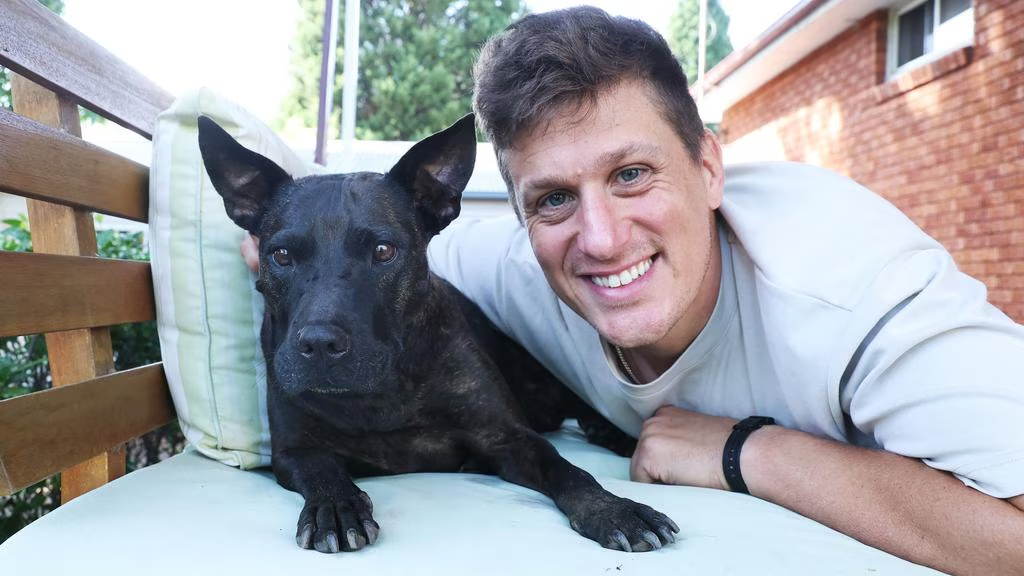
Imagine being told your best friend has months to live. For most, that’s the end of the road—a period of grief and expensive, yet futile, treatments. But when Greg Brockman, a prominent tech leader, found out his dog Bella had terminal cancer, he didn't just accept the prognosis. He opened a laptop.
We often talk about AI in terms of productivity or "vibes," but this story moves the needle into the realm of biological survival. By leveraging the same Large Language Models (LLMs) we use to write emails, Greg embarked on a mission to design a bespoke cancer vaccine.
Bypassing the "No" with Intelligence
Traditional veterinary medicine has its limits, often slowed down by standard protocols and a lack of personalized data. Greg used AI to synthesize complex medical research, identify specific protein targets in Bella's tumor, and essentially "jailbreak" the standard treatment timeline.
He didn't do this in a vacuum. He consulted with experts, but the AI acted as his high-velocity research assistant, connecting dots that might take a human team weeks to find. It’s a classic example of "neuro-linguistic precision" meeting raw biology.
The $15,000 Experiment
Personalized medicine isn't cheap. Greg reportedly spent around $15,000 to bring this AI-designed vaccine to life. While that price tag is steep for many, it highlights a critical trend: the cost of custom-coded biology is crashing.
What was once only possible in elite labs is now happening in the home offices of tech-savvy individuals. We are moving from a world of "one size fits all" medicine to a "segment of one." If you can code it, you might be able to cure it.
A New Era for African Tech
For the tech-savvy crowd in Kenya and across Africa, this isn't just a heartwarming pet story. It is a blueprint. We already see AI being used to bridge the gap in healthcare access across the continent. This DIY approach to high-end medical research suggests that the "gatekeepers" of innovation are losing their grip.
As AI models become more specialized in biology and chemistry, the ability to solve hyper-local health challenges—for humans or animals—becomes a matter of compute and creativity, not just institutional permission.
The Ethical Tightrope
Of course, this raises massive questions. Is it safe to let a chatbot guide medical interventions? We have to balance the "Limbic System" response—the desperate urge to save a loved one—with the "Pre-frontal Cortex" need for safety and proven results.
Greg’s journey with Bella is a signal of a "high-velocity" future where data becomes a physical cure. It’s no longer about whether AI can help; it's about how far you are willing to push the prompts to get the result you need.
The real question isn't whether AI will replace doctors, but whether the doctors of the future will be the ones who know how to architect the best AI-driven solutions. Would you trust a vaccine designed by an algorithm if it was your last hope?