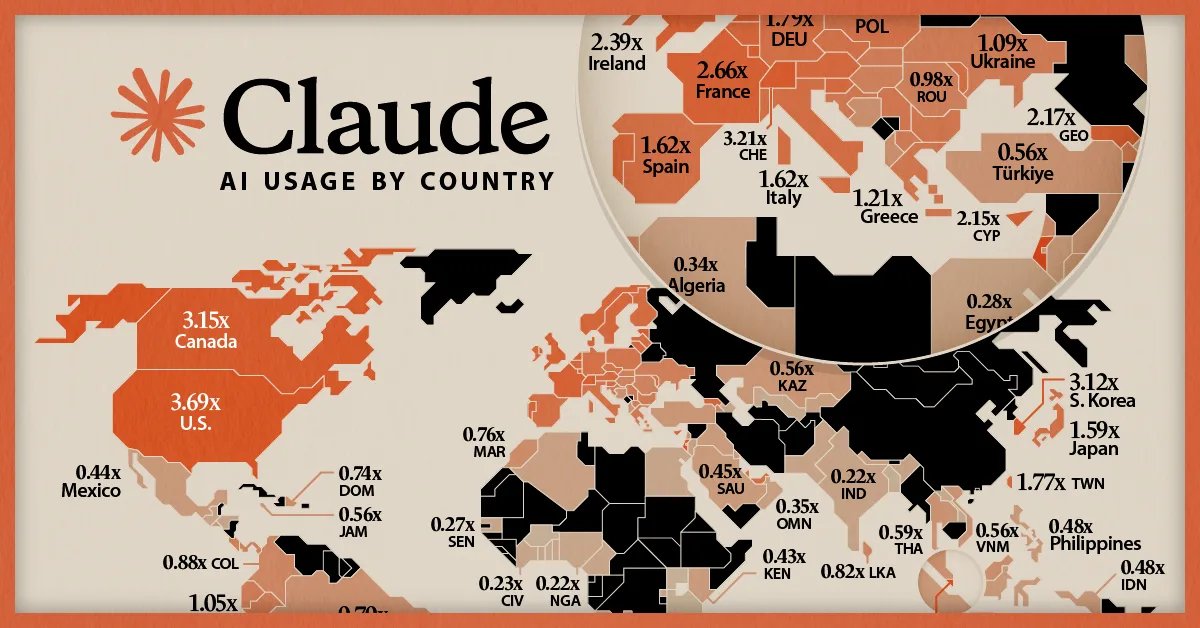
Are you assuming the United States is the undisputed king of artificial intelligence adoption? You are completely wrong. The truth about who is really driving the global AI revolution is hidden in the latest data from Anthropic.
When we look beyond total usage and measure adoption relative to the working age population, a completely different picture emerges. Small nations are quietly outpacing global superpowers. We are witnessing a fundamental shift in how different cultures embrace the tools of tomorrow.
Think of raw AI usage like total coffee consumed in a massive city. A sprawling metropolis will always drink more coffee overall simply because there are more people. But if you want to find the true caffeine addicts, you have to measure cups consumed per person.
The Anthropic AI Usage Index does exactly this for its powerful chatbot Claude. It tracks how intensely a workforce leans on artificial intelligence. The results are nothing short of fascinating.
The True Kings of Claude Adoption
Israel takes the absolute top spot globally with an index score of 4.90x. This should not be too shocking when you consider the region is widely known as the startup nation. Their highly technical workforce clearly treats generative AI as a mandatory daily tool rather than a passing novelty.
Coming in second is Singapore with a score of 4.19x. This vibrant city state has a long history of investing heavily in research and early tech infrastructure. Singaporean professionals are known for adopting new digital skills faster than almost anyone else in the world.
The United States finally appears in third place. While America dominates in sheer volume, it scores 3.69x when adjusted for the size of its workforce. The US still leads the pack if we only look at countries with at least ten thousand Claude conversations.
The Surprising Outliers
Let us look at the full breakdown of the heaviest hitters in the global AI landscape. These nations represent the strongest adoption intensity per capita.
- Israel (4.90x)
- Singapore (4.19x)
- United States (3.69x)
- Australia (3.27x)
- Canada (3.15x)
- South Korea (3.12x)
- New Zealand (3.11x)
You might be wondering about massive populations like Brazil. Brazil generates a huge amount of total activity on Claude. However, when you divide that usage by their massive workforce, their score drops to just 0.7x.
Smaller nations continue to punch above their weight class. Malta scored a very impressive 2.8x, cementing its reputation as a booming European tech hub. Georgia also made the top twenty list with a score of 2.17x as it pushes to integrate artificial intelligence at institutional levels.
Meanwhile, countries like Tanzania and Angola sit at the very bottom of the index at 0.03x and 0.05x. This massive gap highlights a growing digital divide in technological infrastructure and investment worldwide.
What This Means for the Future
We are entering an era where human capital is supercharged by machine intelligence. A smaller country with a workforce that fully embraces AI can easily outcompete a larger nation that lags behind in adoption. It levels the global playing field in ways we have never seen before.
The countries topping this list are not just playing around with chatbots. They are practically 100% committed to building a workforce that knows how to multiply its output and efficiency.
The next time someone tells you AI is just a passing trend, ask them why the most innovative economies on earth are betting their entire future on it.